7 Key Benefits of Whole Abdomen Scan for Early Health Detection

Summer Hydration Care for Children and Dialysis Patients
April 22, 2026
Trimester Scan: A Complete Guide to Healthy Pregnancy Monitoring
May 1, 2026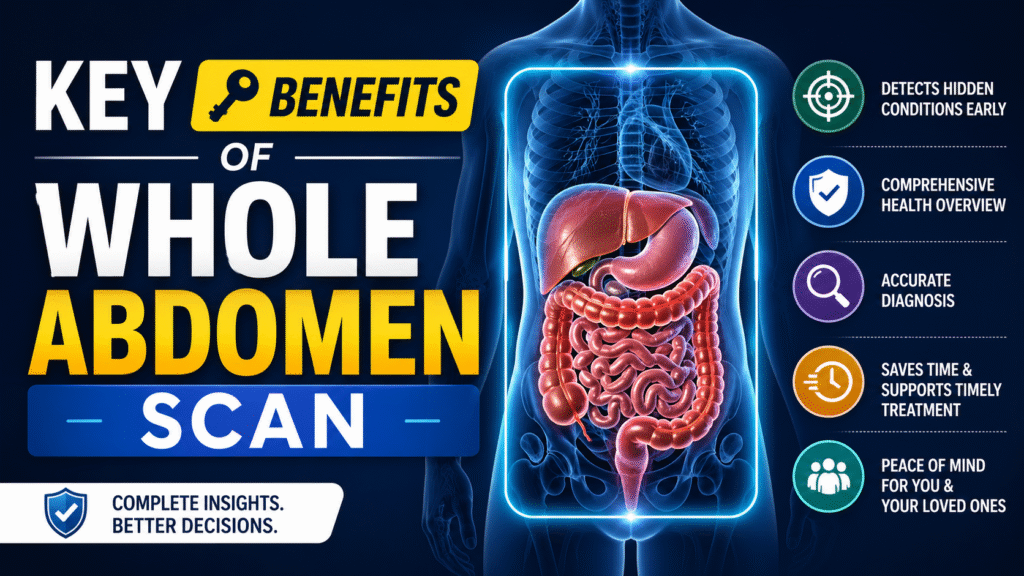
Early detection is no longer a luxury in healthcare. It is the difference between simple treatment and complex intervention.
At the Best Multispecialty Hospital in Sohna Gurgaon, a well-timed Abdomen Scan can uncover hidden conditions before symptoms even begin to appear.
This makes it one of the most valuable diagnostic tools for preventive healthcare today.
In this guide, you will understand exactly how a whole abdomen scan works, why it matters, and how it can help you stay ahead of serious health risks.
What Is a Whole Abdomen Scan and Why It Matters
An Abdomen Scan is a diagnostic imaging procedure that evaluates vital organs such as the liver, kidneys, pancreas, spleen, gallbladder, and major blood vessels.
Depending on the case, doctors may recommend an Abdominal CT or an Abdominal Ultrasound to get detailed insights.
These scans are not just for people with symptoms. Increasingly, they are being used as a proactive health check to detect early-stage abnormalities that are otherwise invisible.
An Abdominal Ultrasound is usually the first step because it is quick, non-invasive, and cost-effective.
On the other hand, an Abdominal CT provides deeper, more detailed imaging when doctors need clarity on complex conditions.
The key idea is simple. Catch problems early, treat them early, and avoid complications later.
1. Early Detection of Hidden Diseases
One of the biggest advantages of an Abdomen Scan is its ability to detect diseases before they become symptomatic.
Conditions like fatty liver, kidney stones, cysts, and tumors often develop silently. By the time symptoms appear, the condition may already be advanced.
An Abdominal CT can identify even small structural abnormalities, while an Abdominal Ultrasound can quickly highlight organ swelling or fluid accumulation.
This is particularly important for identifying risks like Abdominal Aortic Aneurysm, a condition where the main artery in the abdomen enlarges and can rupture if left untreated. Detecting it early can literally save lives.
If you are someone who delays checkups until something feels wrong, this is where you need to rethink your approach.
2. Accurate Diagnosis Without Guesswork
Doctors rely on imaging to confirm what physical examination alone cannot reveal. An Abdomen Scan removes ambiguity from diagnosis.
Instead of prescribing medication based on symptoms alone, doctors can see exactly what is happening inside your body. This leads to more targeted treatment and avoids unnecessary medications.
For example, abdominal pain can have multiple causes. It could be gallstones, liver inflammation, kidney issues, or even vascular conditions like Abdominal Aortic Aneurysm.
An Abdominal CT provides cross-sectional images that help differentiate between these conditions with high precision. Meanwhile, an Abdominal Ultrasound helps in real-time visualization of organs and blood flow.
Better diagnosis means faster recovery and fewer complications.
3. Monitoring Chronic Conditions Effectively
If you already have a diagnosed condition, regular Abdomen Scan evaluations become even more important.
Chronic diseases such as liver disorders, kidney disease, or pancreatic issues require consistent monitoring. Imaging helps track whether the condition is improving, stable, or worsening.
An Abdominal Ultrasound is often used for routine follow-ups because it is safe and repeatable. In more complex cases, an Abdominal CT is used to assess structural changes over time.
Patients with known risks of Abdominal Aortic Aneurysm are often monitored through periodic scans to ensure the condition does not reach a dangerous stage.
Skipping follow-ups is one of the biggest mistakes people make. Monitoring is not optional. It is part of the treatment.
4. Early Detection of Cancer and Tumors
Cancer detection is one area where an Abdomen Scan proves extremely valuable.
Tumors in organs like the liver, pancreas, or kidneys can grow without noticeable symptoms in the early stages. By the time they are detected clinically, treatment options may be limited.
An Abdominal CT is especially useful in detecting abnormal masses, staging cancer, and guiding biopsy procedures. An Abdominal Ultrasound can also detect lumps or abnormal growths, particularly in the liver and kidneys.
Early detection significantly improves survival rates. This is not an exaggeration. It is backed by clinical data across multiple cancers.
If you have a family history of abdominal cancers, regular screening should not be ignored.
5. Evaluation of Digestive and Gastrointestinal Issues
Digestive discomfort is often dismissed as something minor. But recurring issues can indicate deeper problems.
An Abdomen Scan helps identify conditions such as appendicitis, gallstones, liver disease, and intestinal inflammation. It provides a complete picture of the gastrointestinal system.
An Abdominal Ultrasound is commonly used to check gallbladder health and liver conditions. Meanwhile, an Abdominal CT can detect complications like intestinal blockages or internal bleeding.
In some cases, scans can also identify vascular issues such as Abdominal Aortic Aneurysm that may present with vague abdominal discomfort.
If you are repeatedly taking antacids or ignoring persistent pain, you are treating symptoms, not the cause.
6. Detection of Vascular Conditions Before They Become Critical
One of the most serious yet silent conditions detectable through an Abdomen Scan is Abdominal Aortic Aneurysm.
This condition involves the enlargement of the aorta, the main blood vessel supplying blood to the body. It often has no symptoms until it becomes life-threatening.
An Abdominal CT provides detailed imaging of blood vessels, helping doctors measure the size and risk level of the aneurysm. An Abdominal Ultrasound is also commonly used for screening, especially in high-risk individuals.
Risk factors include age, smoking, high blood pressure, and family history.
Early detection allows doctors to monitor or intervene before rupture occurs. Once rupture happens, survival chances drop significantly.
This is one area where preventive screening is not optional. It is critical.
7. Peace of Mind and Preventive Health Strategy
Beyond diagnosis, an Abdomen Scan offers something most people overlook. Peace of mind.
When your scan results are clear, you gain confidence in your health. When something is detected early, you gain time to act.
Preventive healthcare is not just about avoiding disease. It is about staying in control of your health decisions.
An Abdominal Ultrasound is often recommended as part of routine health checkups. In cases where detailed imaging is needed, an Abdominal CT provides deeper insights.
Incorporating scans into your annual or biannual health routine can significantly reduce long-term healthcare risks.
Waiting for symptoms is reactive. Screening is proactive.
When Should You Consider a Whole Abdomen Scan
You should not wait for severe symptoms to consider an Abdomen Scan. Here are practical scenarios where it makes sense:
If you experience persistent abdominal pain, unexplained weight loss, or digestive issues, imaging becomes necessary. If you have a family history of abdominal diseases or Abdominal Aortic Aneurysm, early screening is strongly recommended.
Individuals above 40, especially those with lifestyle risk factors like smoking or poor diet, should consider periodic scans.
Pregnancy, prior surgeries, and existing medical conditions also influence the type of scan recommended. An Abdominal Ultrasound is typically preferred for safety, while an Abdominal CT is used when detailed imaging is required.
Discussing your risk profile with a doctor helps determine the right timing and frequency.
How to Prepare for the Scan
Preparation depends on the type of imaging.
For an Abdominal Ultrasound, fasting for a few hours is often required to get clearer images. For an Abdominal CT, you may be asked to avoid food and, in some cases, take a contrast agent to improve image clarity.
Wear comfortable clothing and follow the instructions provided by your healthcare provider.
The process itself is quick and usually painless. The real value lies in what the results reveal.
Common Myths About Abdomen Scans
There is a misconception that scans are only needed when symptoms are severe. That is outdated thinking.
Another myth is that imaging always exposes you to harmful radiation. While an Abdominal CT does involve radiation, it is controlled and used only when necessary. An Abdominal Ultrasound, on the other hand, uses sound waves and is completely safe.
Cost is another concern, but when compared to the cost of treating advanced diseases, early detection is far more affordable.
Avoiding scans to save money often leads to higher expenses later.
Quick Takeaways You Should Not Ignore
An Abdomen Scan is one of the most effective tools for early disease detection. It helps identify hidden conditions, supports accurate diagnosis, and improves treatment outcomes.
Both Abdominal CT and Abdominal Ultrasound play important roles depending on the situation. They are not interchangeable but complementary.
Conditions like Abdominal Aortic Aneurysm can be life-threatening if undetected, making preventive screening essential.
Your health strategy should not start when symptoms appear. It should start before that.
Final Thoughts
Healthcare is shifting from reactive treatment to proactive prevention. A well-timed Abdomen Scan fits perfectly into this approach.
If you are serious about long-term health, you need to stop relying only on symptoms. By the time your body starts signaling, the problem may already be advanced.
Early detection gives you options, and consulting the Best Radiologist Doctor in Sohna can ensure accurate diagnosis at the right time. Late detection limits them.
If you have been postponing a health check, this is your signal to act. Not later. Now.